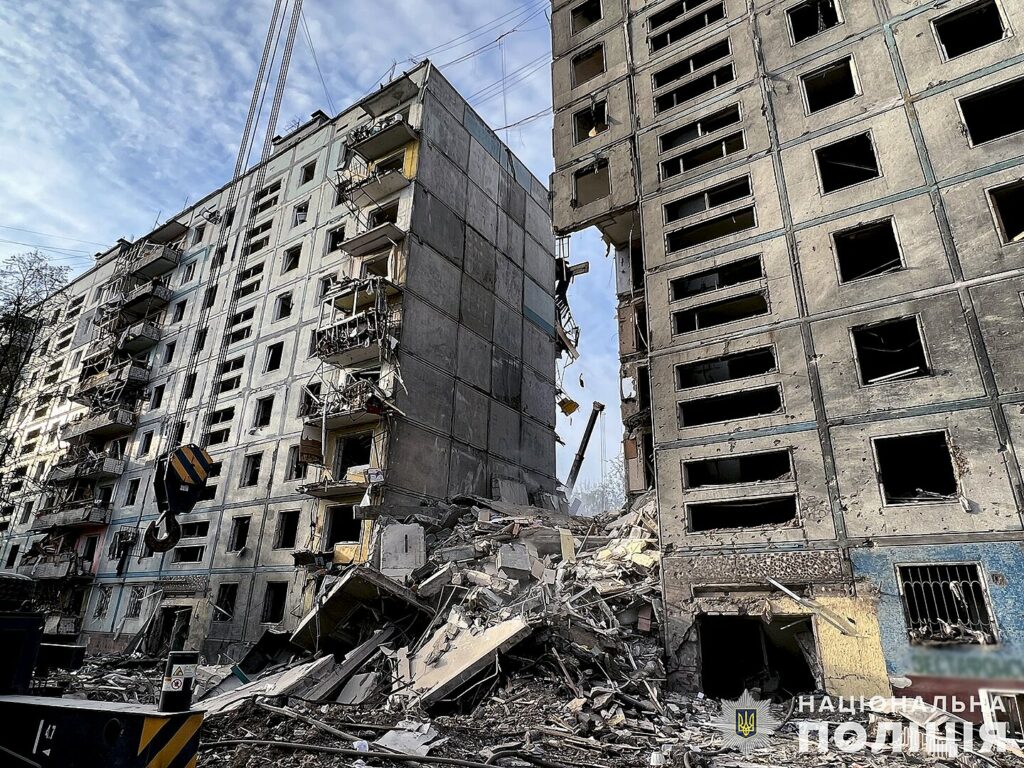
(Scypre.com) – Russia unleashed a sweeping overnight assault on Ukraine early Monday, just hours before a high-stakes NATO meeting spearheaded by former President Donald Trump to fast-track arms deliveries to Kyiv. According to Ukrainian officials, the attack involved over 420 Iranian-made Shahed drones and at least 20 missiles that targeted several major cities, including Kyiv, Kharkiv, and Dnipro. Air raid sirens blared across the country as residential buildings, infrastructure, and a kindergarten were hit. Two civilians were reported killed, and at least 15 others injured, including a 12-year-old boy in Kharkiv. Fire crews battled blazes in several districts of Kyiv, and subway service was suspended following a strike near an underground station in the capital.
The timing of the strikes appeared designed to send a message. NATO defense ministers convened virtually Monday morning in a Ukraine Defense Contact Group session organized at Trump’s urging. The meeting included top officials from the U.S., Germany, and the United Kingdom, along with NATO Secretary-General Mark Rutte and Supreme Allied Commander Gen. Alexus Grynkewich. Their primary goal: to finalize logistics for a new multilateral defense initiative that will see NATO members provide U.S.-made weapons to Ukraine with immediate effect. Under the plan, European nations will fund and deliver key systems such as Patriot missile batteries, while the U.S. will rapidly replenish those stockpiles with newer replacements.
Trump, whose foreign policy pivot drew global attention, had previously halted U.S. military aid to Ukraine earlier in the year but reversed course in July following pressure from European leaders and mounting civilian casualties in Ukraine. In addition to supporting the weapons deal, Trump issued an ultimatum to Russia: negotiate a ceasefire within 50 days or face sweeping tariffs of up to 100% on Russian exports, with potential penalties for countries continuing to trade with Moscow. NATO allies have cautiously welcomed the plan, calling it a necessary escalation to contain Russian aggression while signaling serious economic consequences for noncompliance.
The Kremlin condemned the NATO plan, framing the new arms transfers as “state-sponsored terrorism” and justifying its bombardments as preemptive self-defense. However, the brutality of the strikes, particularly on civilian targets, is likely to backfire internationally. Images of burned-out apartment buildings and injured children circulated widely on Monday, prompting renewed calls for war crimes investigations. The attacks may have reinforced the urgency among NATO members to act decisively. Germany announced the immediate contribution of two Patriot batteries, while Norway, Canada, and Denmark signaled support for expanded air defense packages.
As the summit concluded, Ukraine’s President Volodymyr Zelenskyy reiterated his country’s call for additional long-range systems and hinted that Kyiv may begin limited domestic drone production to ease dependency on foreign suppliers. He also indicated openness to fresh peace talks, though no formal mediation has yet been announced. Meanwhile, NATO logistics teams are preparing to deploy the first wave of military equipment within days. Whether the new initiative changes the trajectory of the war remains uncertain, but Monday’s dramatic escalation makes clear that the conflict is entering a new and dangerous phase.