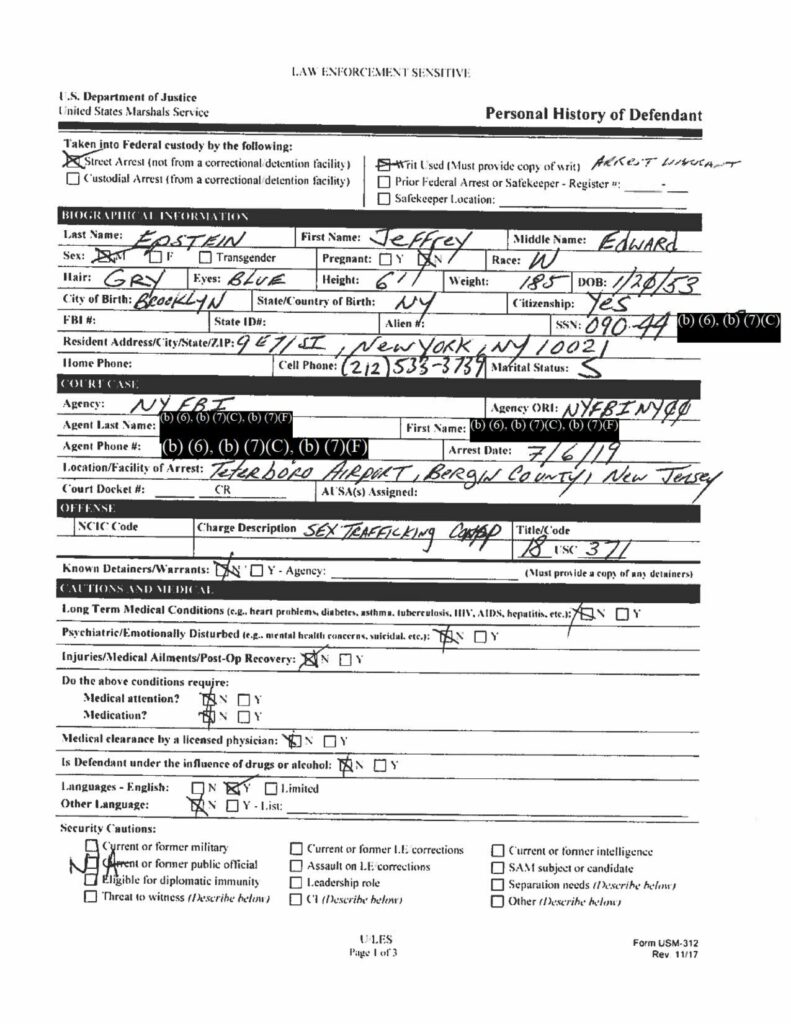
(Scypre.com) – Former President Donald Trump has formally directed Attorney General Pam Bondi to petition the courts for the release of grand jury testimony related to the Jeffrey Epstein investigation. Trump’s announcement, made Thursday evening via Truth Social, reignited long-standing public interest in the Epstein case and drew sharp reactions across the political spectrum. In his post, Trump stated, “Based on the ridiculous amount of publicity given to Jeffrey Epstein, I have asked Attorney General Pam Bondi to produce any and all pertinent Grand Jury testimony, subject to Court approval.” Bondi confirmed the Justice Department would be moving forward, stating in a follow-up post on X that her office was prepared to seek judicial approval “immediately.”
This legal maneuver centers on Federal Rule of Criminal Procedure 6(e), which generally keeps grand jury proceedings secret, but allows for disclosure under exceptional circumstances. Legal experts have noted that the courts have previously made exceptions—such as during the Watergate scandal or the release of the Mueller report—where transparency was deemed in the public interest. Los Angeles trial attorney Neama Rahmani told Fox News that a pathway does exist, explaining that “the requesting party…has to show the need for disclosure outweighs the need for continued secrecy.” Former FBI agent Nicole Parker added that even if testimony were released, sensitive information and victim identities would likely be redacted to protect privacy and prevent retraumatization.
Critics, however, are accusing Trump of political theater. Some analysts argue that the timing is strategic—following backlash from his own supporters who were frustrated that promised Epstein disclosures never materialized. Legal scholars like Professor Barb McQuade of the University of Michigan called Trump’s demand “a meaningless trick” with little likelihood of succeeding in court. Democratic Rep. Daniel Goldman questioned whether grand jury testimony would even contain the information the public seeks, noting it may only relate to Epstein and Maxwell—not to a broader list of individuals alleged to be involved. The Daily Beast and other outlets reported that the move has stirred debate about what exactly could be revealed and whether this is more about optics than substance.
Nonetheless, Trump’s call has found support among several prominent Republicans, including Vice President J.D. Vance and Senate Majority Leader John Thune, who endorsed the effort as a step toward greater government transparency. Meanwhile, Democratic leadership appears split. House Speaker Nancy Pelosi initially dismissed the controversy as a distraction, but reversed her position within an hour, issuing a statement demanding the files be released. The political pressure comes amid reports that Trump is planning legal action against the Wall Street Journal for claiming he once wrote a “bawdy” birthday message to Epstein—allegations he denies outright.
Whether the grand jury testimony will be unsealed remains uncertain. The process requires a federal judge—likely from the Southern District of New York—to rule that public interest outweighs secrecy. This could take weeks or months, and legal experts caution that any disclosure will likely be heavily redacted. Former federal prosecutor Mitchell Epner characterized the timeline as “drawn out” and predicted that legal pushback from third parties, including Epstein’s estate or Maxwell’s attorneys, was inevitable.
Still, the move underscores Trump’s broader messaging as he seeks to portray himself as a crusader for transparency against entrenched institutions. If successful, the release of grand jury material could offer fresh insight into one of the most controversial and mysterious criminal cases of the last two decades. But if denied, the push itself may still serve to galvanize Trump’s base ahead of a high-stakes election cycle. For now, the legal gears are turning, and all eyes are on the courts to determine whether America will get a closer look inside the Epstein files.